Engaging AI: Opportunities and challenges for the social sciences
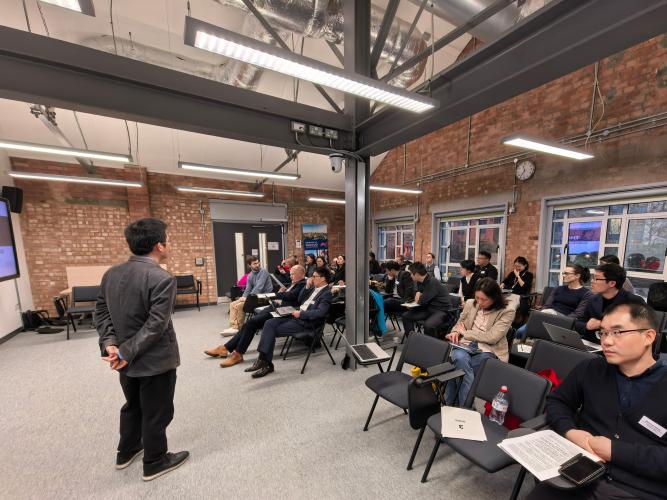
Last term, the Department of Sociology held a two-day international workshop examining the opportunities and challenges that artificial intelligence (AI) presents for today's social science research.
Organised by UKRI Early Career Fellow Dr Fanqi Zeng, as well as Departmental Visitor Professor Xiaoguang Fan (Zhejiang University), the workshop brought together academics from Oxford University and beyond to explore how new AI tools are reshaping sociological inquiry.
Several speakers from the UK and abroad showcased how AI can be used to generate new forms of large-scale social analysis. Dr Zeng discussed his work using AI to model future societal instability, drawing on data about structural constraints faced by different countries and projecting these patterns several decades into the future.
The AI-generated results challenge prevailing predictions of political crisis in various countries, instead suggesting that instability may stem from states' growing inability to manage fiscal constraints that limit revenue amid rising social spending.
Oxford Sociology DPhil student James Manzi similarly demonstrated the potential of Large Language Models (LLMs), describing how he analysed over 600,000 social science abstracts published between 1960 and 2024 to estimate long-run ideological trends within the discipline.
Building on these applications, Dr Michael Heseltine drew on his work with the DemDialogueAI project and the APSA Presidential Taskforce on AI in Political Science to examine both the promise and the limitations of generative AI for social science research.
He highlighted where LLMs perform well, such as in structured classification and controlled simulations, while also identifying persistent challenges including bias, instability, and reproducibility. Dr Heseltine emphasised that AI's real value lies in augmenting established methods rather than replacing them.
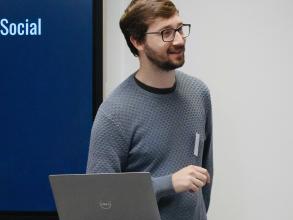
Dr Michael Heseltine
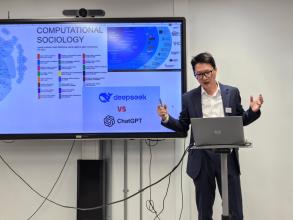
Dr Xiaoguang Fan
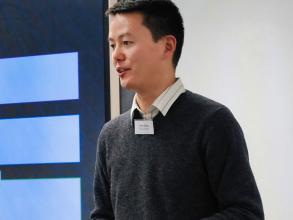
Dr Fanqi Zeng
Methodological innovation emerged as a central theme of the workshop. Co-organiser Professor Xiaoguang Fan highlighted the growing use of LLMs in the social sciences, emphasising their potential to overcome longstanding challenges in empirical sociology by enabling new forms of text analysis, pattern detection, and theory building.
However, he also stressed the risks of over-reliance on such tools, including algorithmic bias and the risk of weakening disciplinary traditions. To overcome these challenges, sociological theory, methodological pluralism, and empirical sensibility must be embedded into the design and use of AI systems.
The Department's Dr José Ignacio Carrasco complemented these discussions with an introduction to agent-based modelling, outlining how simulations based on interacting agents can be used to generate emergent social and population-level patterns.
Throughout the workshop, speakers stressed the importance of engaging with AI critically rather than uncritically embracing it. While AI offers powerful new research tools, its potential lies in supplementing established theoretical and empirical approaches, allowing sociological inquiry to advance without losing sight of its foundational concerns.