From 16,800 applicants to 1,610 awards: Oxford researcher wins global fellowship
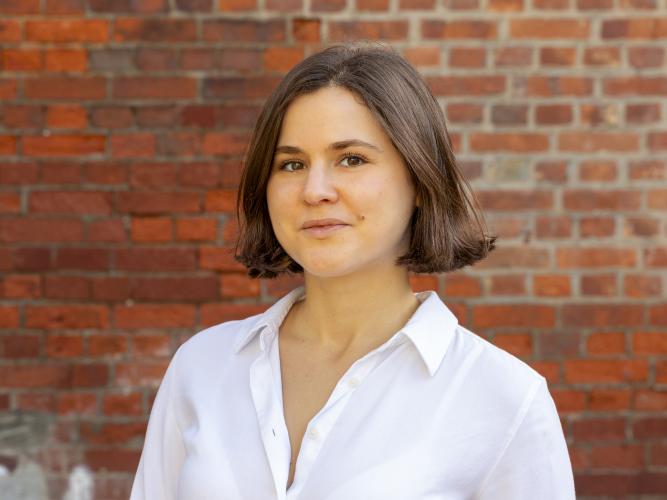
Postdoctoral Research Fellow Emilia Ziosi has been awarded a prestigious Marie Skłodowska-Curie Global Postdoctoral Fellowship at the University of St Andrews' School of International Relations.
This year's competition was the most intense in the 40-year history of the EU's research and innovation framework programme, with over 16,800 eligible proposals submitted and just 1,610 selected.
Emilia has been a member of Oxford's Department of Sociology for the past three years. She spoke about her research, and the role the Department has played in supporting her journey as an Early Career Researcher.
What will you be working on during your Fellowship?
I will be working on the Politics of Illicit Transit (POLIT) project, which will examine how criminal groups and actors coordinate to sustain illicit trade in small transit countries, and how and why coordination arrangements vary across contexts.
It will explore these dynamics across two very different transit contexts within the global cocaine trade: Uruguay and Honduras. Both countries play a crucial yet under-studied role in sustaining drug flows to destination markets in Europe and North America.
As part of my Fellowship, I will spend a year at the Department of Social Sciences at the Catholic University of Uruguay (UCU) in Montevideo, where part of my fieldwork will be based.
What do you hope to achieve with your research?
I hope to advance understanding of how the drug trade functions across transit countries, which remain far less studied than production hubs or destination markets.
Cocaine reaches Europe and North America through long supply chains involving multiple actors and logistics infrastructures. For example, criminal groups often exploit maritime trade infrastructures and legitimate export companies to move drugs across borders and rely on a series of intermediaries and collaborators.
Yet, we still know surprisingly little about how these actors coordinate across different points of the supply chain, especially across transit countries.
I am interested in understanding how coordination emerges and is sustained between the actors involved, and how and why these arrangements vary and function despite the fragmentation that characterises these supply chains.
I hope to generate insights that can inform more effective and context-specific drug and organised crime prevention policies in both Latin America and Europe, but also broader debates around supply chain risks and infrastructural governance within legal trade.
I hope the project can also encourage greater dialogue between researchers, policymakers, and private-sector actors involved in trade and logistics about how to identify and reduce vulnerabilities within global supply chains.
What initially drew you to the Politics of Illicit Transit, and how did your time in the Department help refine that idea into a winning project?
I have been researching organised crime and illicit trade for over five years, always working across disciplines - particularly economic sociology, political science, and criminology.
Engaging with theories on extra-legal markets and governance across these fields has definitely shaped how I think about illicit trade, especially its relational and organisational dimensions. But the intuition for the project itself emerged during fieldwork in Honduras.
We tend to hear about the drug trade only when something goes wrong - when someone gets arrested, or there is a seizure at a port. But when things work, they usually go unnoticed.
During fieldwork, I became increasingly interested in what was working, and how, and I realised that coordination arrangements among actors vary a lot across places. Understanding how and why the drug trade functions despite such differences became the puzzle behind the project.
My time in the Department has helped me anchor these empirical insights and questions within broader, classical sociological debates - like that of social order and governance - particularly through seminars and conversations with faculty and fellow researchers.
I was also fortunate to work on the ERC Advanced Grant CRIMGOV, led by Professor Federico Varese, which brought together a fantastic group of early-career researchers working on organised crime, governance, and illicit economies across different contexts.
The exchanges with the group were important for the development of the project. Empirically, they pushed me to think more comparatively about how illicit trade operates across different settings and for different commodities.
Conceptually, they encouraged me to rethink and unpack categories and labels we often take for granted in organised crime research, including the concept of organised crime itself.
How did the environment in the Department help you develop a project as ambitious and interdisciplinary as POLIT?
There were probably three things that mattered most. First, the Department's intellectual diversity. POLIT really benefited from being developed within a place like Oxford Sociology, where scholars work on different topics and regions, using different theories and methods.
That is really valuable when developing an interdisciplinary project, because it pushes you to clarify your assumptions, questions, and arguments, as well as your contributions.
Second, the Department's research culture. There is a strong commitment to empirically grounded research that engages with real-world problems with analytical rigour. This pushed me to think more ambitiously about the project's theoretical contributions, without losing sight of the empirical puzzle that originally motivated it.
And finally, the Department was a very supportive place to develop as an early career researcher. Beyond opportunities to present work, receive feedback, and have formal and informal conversations with faculty and colleagues, the Department encouraged and supported access to wider opportunities.
For example, small funding pots that researchers can apply for through the Social Sciences Division, or schemes like the Oxford Policy Engagement Network's OPEN Peer Mentoring programme, which I took part in this year.
The latter, especially, is designed to connect researchers and policy professionals to think about how academic research can engage with policymaking. Taking part to it has been very valuable in pushing me to think more concretely about the relevance and impact of my project beyond academia.
What comes next for you and the POLIT project?
I am sad to be leaving the Department after three great years, but I am also really excited to join the School of International Relations at St Andrews.
The School has a long tradition of research on violence, security, and conflict, so it feels like a very stimulating environment in which to develop the next stage of the project. I am looking forward to being part of that intellectual environment and engaging with scholars working on related questions across different regions and disciplines.
The School, and especially my mentor Professor Nicholas Barnes, have also been incredibly supportive throughout the application process. Over the next few years, the main focus will be fieldwork in Uruguay and Honduras, developing the comparative side of the project, and turning the research into a series of articles and, eventually, a book manuscript.
More broadly, I hope the Fellowship will allow me to continue developing a research agenda around illicit trade and global supply chains.