Alum Henrik-Alexander Schubert wins Otto Hahn Medal for DPhil thesis
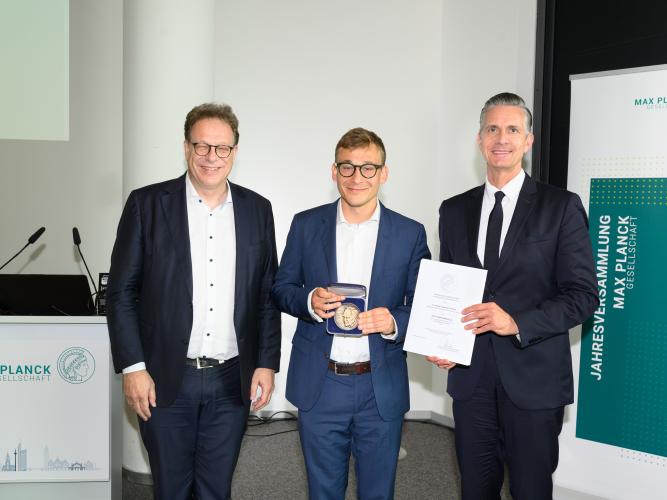
Henrik-Alexander Schubert (centre) with Stefan Vogenauer (left), Director of the Max Planck Institute for Legal History and Legal Theory, and Christian Doeller (right), Vice President of the Max Planck Society © David Ausserhofer / MPG
Congratulations to alumnus Henrik-Alexander Schubert, who has been awarded the Otto Hahn Medal for his Oxford doctoral thesis "The fertility puzzle: Trends and patterns of male and female fertility."
In his thesis, Henrik investigated low fertility and its determinants. Total fertility rates plummeted in the United States and Nordic countries during the 2010s, a decline which occurred across regions, social groups, and different welfare state contexts.
Using large-scale population registry data from various high-income countries, Henrik examined these recent fertility declines and identified the driving factors, concluding that they were multifactorial, pertaining to social, cultural, economic, structural, and biological factors.
The thesis showed that fertility measured for men deviates substantially from fertility measured for women. In high-income countries, fertility is lower and childlessness is higher among men compared to women.
Henrik also made several methodological innovations in his thesis, including approaches to establish cut-offs for substantial sex differences in fertility and a predictive score of couple's fecundity, indicating a high or low biological capacity to have children.
One of Henrik's DPhil supervisors, Professor Christiaan Monden, said:
From the beginning, Henrik showed a remarkable combination of independence, ambition, and collegiality. He was full of ideas, eager to tackle difficult questions, and never intimidated by complex problems.
At the same time, he listened carefully to suggestions and was generous in supporting the work of fellow students and collaborators. These qualities shine through clearly in his thesis, which combines intellectual creativity with methodological rigour.
A member of Nuffield College, Henrik completed his DPhil in 2025 and is now a Research Scientist at the Max Planck Institute of Demographic Research. While at Oxford, he also received the Julia Mead Knox Memorial Prize from the Leverhulme Centre for Demographic Science.
Two chapters of his dissertation have recently been published. "Secularization and low fertility" investigates how recent accelerations in secularisation may have contributed to fertility declines in Finland. Meanwhile, "Subnational birth squeezes" is forthcoming in Demography and investigates sex differences in the total fertility rate at the subnational level, providing methodological approaches to determine significant differences, which are called birth squeezes.
Henrik said:
I am thrilled and honoured to receive the Otto Hahn Medal. The research environments at the MPIDR and Nuffield College were the perfect setting in which to follow my curiosity and pursue my interests.
I was extremely fortunate to have three supervisors - Christian Dudel, Christiaan Monden, and Mikko Myrskylä - who encouraged, challenged, and supported me throughout this endeavour. I am really standing on the shoulders of three giants.
Each year, the Max Planck Society awards the Otto Hahn Medal to a young scientist for outstanding scientific achievements, usually in the context of a doctoral thesis.