
Studies find hidden social expectations influence when people move, marry and have children
Studies find hidden social expectations influence when people move, marry and have children
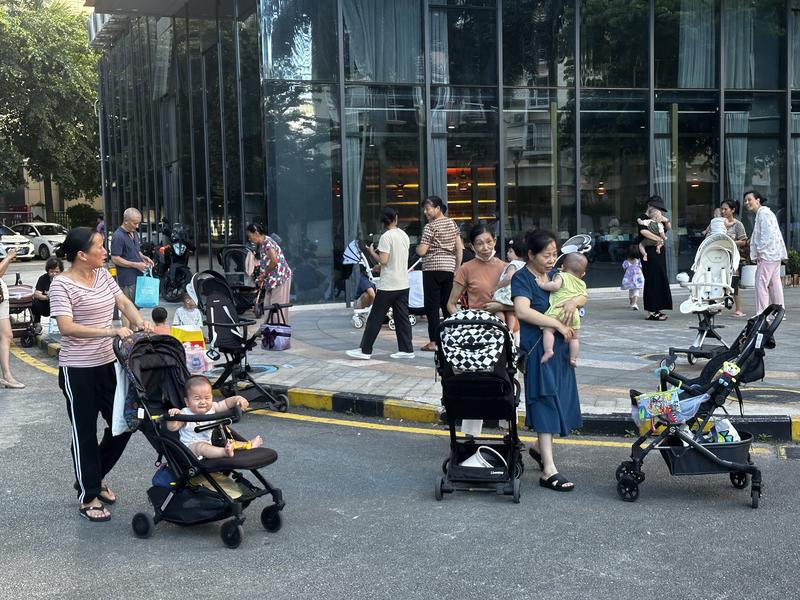
An image of families in Shenzhen, taken by Xijia You.
DPhil student Xijia You has recently published two articles exploring how social norms shape decisions about migration, marriage, and childbearing.
The first article, published in Population, Space and Place, argues that migration and having children are not separate life events, but deeply interconnected decisions shaped by social expectations about family life.
Research on migration and fertility has traditionally been organised around five key mechanisms – socialisation, assimilation, selection, disruption, and adaptation – which are typically examined in isolation.
But Xijia argues that these mechanisms are actually all driven by fertility norms – the social expectations about when and how many children to have.
Drawing on 66 life-story interviews with internal migrants in Shenzhen, China, the study demonstrates that fertility norms provide a common framework through which all five classical theories can be connected.
The paper presents a timeline of the process, revealing that prior to migration, individuals choose where to live in light of anticipated fertility norms (selection).
During migration and settlement, geographic separation from origin communities weakens the pressures of fertility norms, allowing space for revised reproductive plans (disruption).
Over time, living in a new place reshapes people’s fertility priorities and practices (adaptation), all unfolding against the longer-term influence of childhood socialisation and intergenerational assimilation.

A Shenzhen railway station poster encouraging internal migration. It reads “17.56 million + 1 = Shenzhen,” inviting newcomers to see themselves as the “+1” shaping the city.
The study shows that individuals are not only responding to economic pressures or the disruptions associated with moving, but also to competing social expectations about when, whether, and under what conditions to have children.
In this way, the framework connects large-scale population patterns (such as fertility trends) to the everyday decision-making processes through which individuals build a coherent life story.
Xijia said:
This research is significant as it shows that social norms can play a central role in shaping fertility behaviours.
It also shows that individuals are not passive actors shaped only by structural conditions or fixed preferences; instead, they actively and strategically negotiate competing social expectations across different places.
Xijia’s second study, published in Time & Society, examines how expectations about the length of time spent in different life stages influence family formation decisions.
Drawing on interviews with 55 individuals in Shenzhen, the research introduces the concept of ‘duration norms’ – socially constructed expectations about how long relationships, marriages, or periods without children should last.
While existing scholarship has focused primarily on age norms (the ‘right’ age to marry or have children) and sequencing norms (the expected order of life events), this study demonstrates that duration constitutes a distinct and influential temporal dimension in its own right.
The findings show that duration norms operate as fully developed social norms. Participants described widely shared expectations about what counts as “too long” in a relationship or “too late” to have children after marriage.
These expectations are not merely descriptive but carry evaluative force, often accompanied by social sanctions such as criticism, concern, or pressure from others.
Unlike age norms, which are tied to specific numerical thresholds, duration norms operate through more flexible, context-dependent boundaries. Judgements are made in relative terms – for example, whether a relationship has lasted “long enough” to justify marriage.
This absence of clear limits actually expands the scope for social evaluation, exposing individuals to multiple and sometimes conflicting judgements from family members and wider social networks.


The study also challenges the idea that delays in marriage or childbearing are mainly due to economic factors, such as housing costs or career pressures.
Instead, it argues that time itself becomes moralised – meaning that how long someone waits is judged as right or wrong, regardless of the reasons.
Together, these findings add a new dimension to how family formation decisions are understood. Rather than focusing only on when things happen or in what order, we must also consider how long people are expected to remain in each stage.
These expectations form a temporal framework that shapes major life transitions. Recognising this additional dimension provides a more nuanced account of how individuals navigate family formation and contributes to broader efforts to understand demographic change in rapidly transforming urban contexts.
Xijia adds:
Although this study focuses on urban China, similar patterns are likely to exist in other contexts. Recognising these often-overlooked ‘time rules’ can improve how we understand global trends in marriage and fertility, and help policymakers respond more effectively to changing family behaviours.
Ultimately, when it comes to major life decisions, it is not just chronological age that matters, but how long society expects each stage of life to last.

